During the Aufruf on Saturday, I was thinking about the Jewish agricultural laws the Rabbi mentioned. I was curious, especially after reading the "Gift of Good Land" essay by Wendell Berry immediately following the Aufruf. What are the common religious agricultural laws that tend to be repeated over and again in different religions?
For me, that's a tough question. I don't have a strong religious background in any particular religion, although I see that more of as an advantage than a disadvantage: I can see objectively, and I'm equally ignorant of all religions.
I have found, so far, that the laws of Seder Zeraim include dedicating a particular percentage of a yield to supporting the priests and those who serve in the temple, as well as the poor who do not have land of their own (leaving the harvest in the corners for the poor - 1/60 of the field and 1/10th of the produce). One law limits how much you can produce, and prohibits the mixing of seed in the field. Additionally, fields must lie fallow on the seventh year (no pruning, no sowing of seed). There is a prohibition against eating fruit from a tree less than three years old.
I find this fascinating. Written into the instructions for community members to follow year in and year out are laws that help maintain not only the community, but soil health and vitality. Built in fallow periods - very practical. And it might just keep a society from eroding or depleting their soils and eventually starving.
Tuesday, May 13, 2008


Monday, May 12, 2008
The Awakening
Have you noticed that suddenly there are earthquakes going on everywhere? Within the past few weeks, there has been a 6.8 magnitude earthquake in Japan, a mysterious 2-month long series of earthquakes in Reno, NV, and even an earthquake in Illinois. And just today, a massive 7.9 magnitude earthquake in China.
It's not just earthquakes: think of all the volcanos that have suddenly been in the news recently. There is the Chaiten volcano in Chile that suddenly started erupting for the first time in thousands of years. Kilauea volcano in Hawai'i National Park has suddenly become much more active, resulting in some areas of the park to be evacuated.
All of this within the past few weeks - since mid-April or so. Everything is just getting all shook up. It makes sense, but it's still a little worrisome. Is all this just a precursor to even more eruptions and earthquakes? Or was today's massive Chinese earthquake the culmination?
We are very rapidly becoming immune to large death tolls in the headlines. The UN death toll estimate for the Myanmar cyclone last week is around 100,000 people. The death toll for today's earthquake in China is in the thousands. (Update: the death toll for the China earthquake is now close to 12,000 people as of the morning of May 13).
In the U.S., we aren't having the same kind of death tolls, luckily, but we do seem to be having more severe weather than usual this year. There was the Super Tuesday tornado outbreak that killed 57 people. Then there was the tornado that struck downtown Atlanta. Over the weekend, there were tornadoes in Oklahoma & Kansas that killed an additional 22 people.
So far this year, we've had 910 tornadoes in the U.S., and it's still only the beginning of May. In general, the U.S. averages about 1200 tornadoes a year. By the end of May in 2007, there had been 799 tornadoes reported, with a total of 1305 for the whole year. We still have to get through May, but the remainder of the year should have about 30% of our yearly tornado totals... which would indicate that we are on track to get about 570 additional tornadoes this year.
Spring this year is bringing with it a whole slew of depressing geologic & climatic events. They are unlikely linked - unless you consider the ash plumes from the volcanoes entering the atmosphere and influencing weather patterns (which does happen). As the earth awakens this spring, it appears she is angry and is on a murderous rampage.
It's not just earthquakes: think of all the volcanos that have suddenly been in the news recently. There is the Chaiten volcano in Chile that suddenly started erupting for the first time in thousands of years. Kilauea volcano in Hawai'i National Park has suddenly become much more active, resulting in some areas of the park to be evacuated.
All of this within the past few weeks - since mid-April or so. Everything is just getting all shook up. It makes sense, but it's still a little worrisome. Is all this just a precursor to even more eruptions and earthquakes? Or was today's massive Chinese earthquake the culmination?
We are very rapidly becoming immune to large death tolls in the headlines. The UN death toll estimate for the Myanmar cyclone last week is around 100,000 people. The death toll for today's earthquake in China is in the thousands. (Update: the death toll for the China earthquake is now close to 12,000 people as of the morning of May 13).
In the U.S., we aren't having the same kind of death tolls, luckily, but we do seem to be having more severe weather than usual this year. There was the Super Tuesday tornado outbreak that killed 57 people. Then there was the tornado that struck downtown Atlanta. Over the weekend, there were tornadoes in Oklahoma & Kansas that killed an additional 22 people.
So far this year, we've had 910 tornadoes in the U.S., and it's still only the beginning of May. In general, the U.S. averages about 1200 tornadoes a year. By the end of May in 2007, there had been 799 tornadoes reported, with a total of 1305 for the whole year. We still have to get through May, but the remainder of the year should have about 30% of our yearly tornado totals... which would indicate that we are on track to get about 570 additional tornadoes this year.
Spring this year is bringing with it a whole slew of depressing geologic & climatic events. They are unlikely linked - unless you consider the ash plumes from the volcanoes entering the atmosphere and influencing weather patterns (which does happen). As the earth awakens this spring, it appears she is angry and is on a murderous rampage.
Aufruf, Part II
Upon further reflection, the readings from the Torah during the Aufruf were focused on the Laws governing who the priest's son could marry, and who is allowed to do what. The most interesting thing is that the book we were reading from wasn't an old archaic text - there was a modern English translation & discussion of sorts beneath the English translation of the laws in Hebrew. There was some mention of disabled people being unable to do certain things, but the English discussion section indicated that in today's societies, "we" do not discriminate based on physical appearances or abilities. It was really good to read - and I like the idea that "they" were willing to write in their prayer book that things are different now. It seems like such a little thing - but the last time I cracked open a bible in a church, I saw no such disclaimers, footnotes, explanations or summaries.
The Rabbi also called attention to readings further beyond the Aufruf readings - the laws that govern certain holidays, and how they tied in with traditional agriculture (he actually said "if you read ahead..."). The laws ensured that the planting would be done on time, the harvesting would be done on time, and that God was properly thanked for these miracles (or something along these lines - I didn't have time to read very much of it). It struck me how very suddenly people have become disassociated with these natural patterns of life. We now have all of these holidays (regardless of which religion may claim you, if any) that have their roots firmly in our agricultural history. Until very recently, we were a subsistence economy. Those laws are in the Torah simply for human survival, to remind people that they need to do certain things at certain times - these rules are important enough to follow that they formed a portion of our very spiritual study, so that we would not forget them.
And currently, these laws seem irrelevant in day to day life to the average person. Very few people know the actual origins of holidays in our society - they are seen merely as a day off of work (or school), or an occasion to go out drinking on a 3-day weekend or an excuse to exchange gifts. We now live in a world where people don't know the very traditions that have allowed numerous generations to survive, to create us in our current form. We all have a very long history that extends back to a very few people - but very few people know how we got to where we are today.
As I am now just finishing up Wendell Berry's "The Gift of Good Land" (a collection of essays), I found this part of the Aufruf service particularly interesting. The final essay, #24 (titled "The Gift of Good Land"), is discussing God, community, and how good Judeo-Christian people are required by their faith to be stewards of their land. Berry discusses how the Amish are so successful at agriculture while the average farmer is not (in the early 1980s, anyway) because they do not rule over the land, but nearly watch over it and take care of it as stewards. The Amish view the land as a gift from God; they don't "own" it, but they are merely borrowing it. The Amish also are very focused on their community and the welfare of all of those in it; they give freely of what they have so that their neighbor may succeed, and they recognize the yet unborn next generation as their neighbors and part of their community as well. And so they treat the land carefully; it's God land, and it is not only for their use, but for the use of their neighbors and the next generation. Which, naturally, leads to very sustainable farming practices.
Berry also frequently brings up "right livelihood' ("right work") from the Noble Eightfold Path, which means that you should choose a job that does not harm others. Berry insists that "others" includes everyone and everything - there is no "right work" in strip mining, and there is no "good christian strip mine". He allows that there is no way we can live without harming anything else - we live on the deaths of other creatures - but we can do our best to have the smallest impact as possible by applying the technologies we have in a responsible manner, individually suited to each individual application.
The Rabbi also called attention to readings further beyond the Aufruf readings - the laws that govern certain holidays, and how they tied in with traditional agriculture (he actually said "if you read ahead..."). The laws ensured that the planting would be done on time, the harvesting would be done on time, and that God was properly thanked for these miracles (or something along these lines - I didn't have time to read very much of it). It struck me how very suddenly people have become disassociated with these natural patterns of life. We now have all of these holidays (regardless of which religion may claim you, if any) that have their roots firmly in our agricultural history. Until very recently, we were a subsistence economy. Those laws are in the Torah simply for human survival, to remind people that they need to do certain things at certain times - these rules are important enough to follow that they formed a portion of our very spiritual study, so that we would not forget them.
And currently, these laws seem irrelevant in day to day life to the average person. Very few people know the actual origins of holidays in our society - they are seen merely as a day off of work (or school), or an occasion to go out drinking on a 3-day weekend or an excuse to exchange gifts. We now live in a world where people don't know the very traditions that have allowed numerous generations to survive, to create us in our current form. We all have a very long history that extends back to a very few people - but very few people know how we got to where we are today.
As I am now just finishing up Wendell Berry's "The Gift of Good Land" (a collection of essays), I found this part of the Aufruf service particularly interesting. The final essay, #24 (titled "The Gift of Good Land"), is discussing God, community, and how good Judeo-Christian people are required by their faith to be stewards of their land. Berry discusses how the Amish are so successful at agriculture while the average farmer is not (in the early 1980s, anyway) because they do not rule over the land, but nearly watch over it and take care of it as stewards. The Amish view the land as a gift from God; they don't "own" it, but they are merely borrowing it. The Amish also are very focused on their community and the welfare of all of those in it; they give freely of what they have so that their neighbor may succeed, and they recognize the yet unborn next generation as their neighbors and part of their community as well. And so they treat the land carefully; it's God land, and it is not only for their use, but for the use of their neighbors and the next generation. Which, naturally, leads to very sustainable farming practices.
Berry also frequently brings up "right livelihood' ("right work") from the Noble Eightfold Path, which means that you should choose a job that does not harm others. Berry insists that "others" includes everyone and everything - there is no "right work" in strip mining, and there is no "good christian strip mine". He allows that there is no way we can live without harming anything else - we live on the deaths of other creatures - but we can do our best to have the smallest impact as possible by applying the technologies we have in a responsible manner, individually suited to each individual application.
Saturday, May 10, 2008
Aufruf
We attended a friends Aufruf ceremony today - the ceremony where he and his fiance read from the Torah, or before the Torah. I'm still not quite sure what went on, but it was really touching to have been invited to such personal & family-oriented occasion. I suppose it's much like announcing your impending marriage before God, before your family, your friends & the community you grew up with.
Social activites such as the one today are completely draining. I'm so fearful of inadvertantly offending someone that I rarely actually enjoy the event. But then I was able to think back to my own wedding, and it occurs to me that I was way too preoccupied to care what other people were doing. Nevertheless, when I got home, I was ready for a nap.
Today's ceremony brought me back to the idea of community. I can see how it's very possible that there is no community like the Jewish community, at least from what I can tell from my brief interaction with it today. It definitely seemed like a very large family. Very tight, very personal, very interactive. I understood very little of the service - but one thing was very apparent: there was a great deal of love and support for our friend & his family. And I wonder - is this community feeling particular to this one families' experience, or one congregation's experience, or it is fairly common among all the congregations? Is it the shared bond of persecution and adversity? Or does that have nothing to do with it at all?
Social activites such as the one today are completely draining. I'm so fearful of inadvertantly offending someone that I rarely actually enjoy the event. But then I was able to think back to my own wedding, and it occurs to me that I was way too preoccupied to care what other people were doing. Nevertheless, when I got home, I was ready for a nap.
Today's ceremony brought me back to the idea of community. I can see how it's very possible that there is no community like the Jewish community, at least from what I can tell from my brief interaction with it today. It definitely seemed like a very large family. Very tight, very personal, very interactive. I understood very little of the service - but one thing was very apparent: there was a great deal of love and support for our friend & his family. And I wonder - is this community feeling particular to this one families' experience, or one congregation's experience, or it is fairly common among all the congregations? Is it the shared bond of persecution and adversity? Or does that have nothing to do with it at all?
Thursday, May 08, 2008
Energy Raisers
The Boston Globe does it again - the wrote something I actually enjoyed reading and caused much thinking. Amazing. Is it possible they are changing? Is it a sign of the Apocalypse?
Energy Raisers - like an Amish barn raising - where neighbors descend upon each others houses to install solar hot heaters on the cheap. $3,000 instead of the commercially installed $10,000. Same system - free labor. It's a great idea.
The headline is a bit wordy: Many Hands Make Light Work of Saving Energy, but its still exciting. The gist is this: there is a group in the Plymouth, NH area that has figured out a way to help themselves and their neighbors by donating time to help install solar hot water systems. On a given Saturday, they all descend on a chosen house (whose owner also helps install systems on other peoples houses before & after their own installation), and they get it done in one day.
The Citizen of Laconia also ran a similar article earlier this week. Which led me to finding the Plymouth Area Renewable Energy Initiative. The group is a non-profit, and they've been around since 2004, and have done 50 solar installations to date. Membership costs $55 per year (for a family), and in return you a) help them and b) have access to all sorts of energy assessments, research tools, product discounts, networking/mentoring opportunities, discounts to training seminars & workshops, the opportunity to participate in energy raisers, and access to their library. It seems to be set up very well, and the membership cost seems reasonable.
Knowledge is a funny thing. You might pay (or work) once for it, but you use it continuously (barring any head injuries). And then you can pass it on to others.
-------------
On a side note, I was not the only one who was exhausted yesterday. My neighbor across the street came home as we were fixing dinner last night. She backs into her driveway and her headlights shine right in through our kitchen window (a bit annoying). Well, her lights didn't go off. After about a half hour, I went over to her house and knocked on the door (I have talked to these people once - they also sent out an invitation to an open house at their house once, but then weren't home on said date - very annoying - and it wasn't just me - some other neighbors also went over, knocked on the door, and found no one home. No explanation was ever offered. Very odd & a bit rude. I'm not entirely convinced these people are really "with it" - I've also seen them drive by their own house and go into reverse down the street to get back to it. How do you miss your own driveway?). So anyway - once again - no answer. So I shrug and leave - let her run her battery down then. As I was walking down the driveway, I noticed the lights had turned off. She got out of the car, and had apparently fallen asleep in her driveway. Thankfully she put it in park first. I need to plant some more trees between us & them. Big, strong trees with lots of leaves.
Energy Raisers - like an Amish barn raising - where neighbors descend upon each others houses to install solar hot heaters on the cheap. $3,000 instead of the commercially installed $10,000. Same system - free labor. It's a great idea.
The headline is a bit wordy: Many Hands Make Light Work of Saving Energy, but its still exciting. The gist is this: there is a group in the Plymouth, NH area that has figured out a way to help themselves and their neighbors by donating time to help install solar hot water systems. On a given Saturday, they all descend on a chosen house (whose owner also helps install systems on other peoples houses before & after their own installation), and they get it done in one day.
The Citizen of Laconia also ran a similar article earlier this week. Which led me to finding the Plymouth Area Renewable Energy Initiative. The group is a non-profit, and they've been around since 2004, and have done 50 solar installations to date. Membership costs $55 per year (for a family), and in return you a) help them and b) have access to all sorts of energy assessments, research tools, product discounts, networking/mentoring opportunities, discounts to training seminars & workshops, the opportunity to participate in energy raisers, and access to their library. It seems to be set up very well, and the membership cost seems reasonable.
Knowledge is a funny thing. You might pay (or work) once for it, but you use it continuously (barring any head injuries). And then you can pass it on to others.
-------------
On a side note, I was not the only one who was exhausted yesterday. My neighbor across the street came home as we were fixing dinner last night. She backs into her driveway and her headlights shine right in through our kitchen window (a bit annoying). Well, her lights didn't go off. After about a half hour, I went over to her house and knocked on the door (I have talked to these people once - they also sent out an invitation to an open house at their house once, but then weren't home on said date - very annoying - and it wasn't just me - some other neighbors also went over, knocked on the door, and found no one home. No explanation was ever offered. Very odd & a bit rude. I'm not entirely convinced these people are really "with it" - I've also seen them drive by their own house and go into reverse down the street to get back to it. How do you miss your own driveway?). So anyway - once again - no answer. So I shrug and leave - let her run her battery down then. As I was walking down the driveway, I noticed the lights had turned off. She got out of the car, and had apparently fallen asleep in her driveway. Thankfully she put it in park first. I need to plant some more trees between us & them. Big, strong trees with lots of leaves.
Wednesday, May 07, 2008
Exhausted
Well, I've been more tired, anyway, but I'm pretty damn tired. 'Tis the season.
We planted leeks today, and prepared more planting beds. Which involved a lot of hand-tilling of very heavy soil. It wasn't hard at all, but it was early - 6 a.m. - but at least it wasn't raining. On the other hand, the black flies are pretty bad - no wonder they call them "Mayflies." I got the crap scared out of me by hoeing up a chicken wing - feathers still attached - apparently I jumped quite a bit. Not exactly what I thought I might find in the planting bed. Rocks, yes. Dismembered chicken parts, not so much.
After several hours of cleaning the house, I moved several hundred pounds of rock (a freebie rock pile is always good). Not exactly sure what I'll use the rock for, but it wont go to waste. It was free - what can I say? I have about 2 more days of rock- moving to do. I have one load still in the truck because I didn't have the time or energy to unload it. Maybe I'll build an herb pyramid. More likely, the rock will sit in a giant pile there for a few years and then I'll decide to do something with it.
The apple and cherry trees are blooming. The apple trees seem to really like the pruning they got last winter. I really need to learn how to do that the right way - although at this point my hack job seems to be helping. The compost application to the roots probably didn't hurt. I took some blossom photos with the large format yesterday - maybe tomorrow I'll use the digital. They really are beautiful.
This afternoon I went to a neat farm visit at a nearby farm about cover crops - *J* introduced me to CRAFT, which stands for "Collaborative Regional Alliance for Farmer Training." Of course, it was somewhat of an awkward social event (as all social events are), but it was also full of good information. My theory on cutting down the winter rye & leaving it in between the rows has been completely validated, which makes me happy - it's just about too late to do anything else with it anyway. Interestingly, mowing the winter rye is a good move - it stimulates root growth (which, once stated, made me think: "Duh", but hadn't previously occurred to me). Then you can plow it under - or not, apparently.
We planted leeks today, and prepared more planting beds. Which involved a lot of hand-tilling of very heavy soil. It wasn't hard at all, but it was early - 6 a.m. - but at least it wasn't raining. On the other hand, the black flies are pretty bad - no wonder they call them "Mayflies." I got the crap scared out of me by hoeing up a chicken wing - feathers still attached - apparently I jumped quite a bit. Not exactly what I thought I might find in the planting bed. Rocks, yes. Dismembered chicken parts, not so much.
After several hours of cleaning the house, I moved several hundred pounds of rock (a freebie rock pile is always good). Not exactly sure what I'll use the rock for, but it wont go to waste. It was free - what can I say? I have about 2 more days of rock- moving to do. I have one load still in the truck because I didn't have the time or energy to unload it. Maybe I'll build an herb pyramid. More likely, the rock will sit in a giant pile there for a few years and then I'll decide to do something with it.
The apple and cherry trees are blooming. The apple trees seem to really like the pruning they got last winter. I really need to learn how to do that the right way - although at this point my hack job seems to be helping. The compost application to the roots probably didn't hurt. I took some blossom photos with the large format yesterday - maybe tomorrow I'll use the digital. They really are beautiful.
This afternoon I went to a neat farm visit at a nearby farm about cover crops - *J* introduced me to CRAFT, which stands for "Collaborative Regional Alliance for Farmer Training." Of course, it was somewhat of an awkward social event (as all social events are), but it was also full of good information. My theory on cutting down the winter rye & leaving it in between the rows has been completely validated, which makes me happy - it's just about too late to do anything else with it anyway. Interestingly, mowing the winter rye is a good move - it stimulates root growth (which, once stated, made me think: "Duh", but hadn't previously occurred to me). Then you can plow it under - or not, apparently.
Saturday, May 03, 2008
If you have to rebuild a town anyway...
Greensburg, KS : This weekend the town is hosting something that resembles a grand re-opening of their town. One year ago tomorrow, 90% of the town was wiped out by a tornado. Homes, businesses, schools, town offices, infrastructure - everything. Making the best of a horrible situation, the town has chosen not only to rebuild itself, but is also rebuilding itself green. "Greensburg GreenTown" would seem almost too cute to be true, had it not been for the horrible reality of having virtually an entire town wiped out in a few short minutes and the enormous amount of work they've accomplished in the last year.
The largest business in town, the local John Deer dealer, was badly hit. But they are rebuilding to LEED standards- they are trying to go Platinum - the highest LEED rating possible. The town itself is trying to use 100% renewable energy.
In December 2007, the city council also voted to become the first city in the US to demand that all city-owned buildings be LEED Platinum certified.
They've even recycled their damaged trees. They are also looking for donations of new trees.
They have future plans for a green industrial park in the city as well.
On April 4, 2008, the town starting distributing two-button flush-style water saving toilets to it's residents.
How is an older, rural farming community on the plains managing to pull off this ultra-green conversion? The town leaders have apparently managed to spread the ideals of energy efficiency and renewable resources in a non-political way: they've framed the green ideals not as a hippie-type earth friendly thing to do but as a common-sense move to control energy costs. In doing so, they hope to keep not only the businesses they had before the tornado upended their town, but also attract new green businesses.
I wonder how much tourism this will generate. If you build it, will they come?
Now, if we could only convince those that live in town the switchgrass is just as good as a lawn - then they could send their cuttings to the local biodeisel plant.
------
On an interesting side note, I've just heard that Pres. Bush will be speaking at their high school commencement this week. That's kind of funny. A community of white people get wiped out, and a year later they have rebuilt to a great extent, and the President comes to their high school graduation. When was the last time the President visit the Gulf Coast? How well is the rebuilding going down there?
The largest business in town, the local John Deer dealer, was badly hit. But they are rebuilding to LEED standards- they are trying to go Platinum - the highest LEED rating possible. The town itself is trying to use 100% renewable energy.
In December 2007, the city council also voted to become the first city in the US to demand that all city-owned buildings be LEED Platinum certified.
They've even recycled their damaged trees. They are also looking for donations of new trees.
They have future plans for a green industrial park in the city as well.
On April 4, 2008, the town starting distributing two-button flush-style water saving toilets to it's residents.
How is an older, rural farming community on the plains managing to pull off this ultra-green conversion? The town leaders have apparently managed to spread the ideals of energy efficiency and renewable resources in a non-political way: they've framed the green ideals not as a hippie-type earth friendly thing to do but as a common-sense move to control energy costs. In doing so, they hope to keep not only the businesses they had before the tornado upended their town, but also attract new green businesses.
I wonder how much tourism this will generate. If you build it, will they come?
Now, if we could only convince those that live in town the switchgrass is just as good as a lawn - then they could send their cuttings to the local biodeisel plant.
------
On an interesting side note, I've just heard that Pres. Bush will be speaking at their high school commencement this week. That's kind of funny. A community of white people get wiped out, and a year later they have rebuilt to a great extent, and the President comes to their high school graduation. When was the last time the President visit the Gulf Coast? How well is the rebuilding going down there?
Friday, May 02, 2008
Wild Apples
Last night I attended the launch party of the new local litterary and arts journal Wild Apples. They had a pretty good turn out. I went with *J* and her family, and was introduced to one of the editors of the journal. Which, of course, was a painfully socially awkward event. I hate meeting people - I have no idea what to do with myself, and I'm sure I come across as having something "wrong" with me.
It was a nice event (by small town standards- I was pretty impressed), and we were able to listen to a poetry reading by one of the contributors (we left early, as *J*s baby was not feeling so well, the poor thing). It's really neat to know that our area has produced an artsy journal of its own- locally based. There's some comfort in that. There's a lot of comfort in that. I'm delighted to know that there are enough interested people around to support such a endeavor in our little corner of the world.
In the past few months, I've come to realize that all of the searching for home in various localities has been - well, not a waste, perhaps, but a bit misguided. We've been looking for a magical place that we can move to and feel comfortable and connected instantly. Ironically, it was here all along. I just had to dig deeper. Perhaps this housing bubble burst could be one of the most important events in my life. It's forced me to abandon the "move along" attitude and really settle in and get to know a place. I'm continuously surprised that our more or less "snap" decision to move to this particular house in this particular town may have been a sound one, and we may, actually, really fit in after all.
There is a lesson in there somewhere. It's down there somewhere. Guess I'll keep digging.
It was a nice event (by small town standards- I was pretty impressed), and we were able to listen to a poetry reading by one of the contributors (we left early, as *J*s baby was not feeling so well, the poor thing). It's really neat to know that our area has produced an artsy journal of its own- locally based. There's some comfort in that. There's a lot of comfort in that. I'm delighted to know that there are enough interested people around to support such a endeavor in our little corner of the world.
In the past few months, I've come to realize that all of the searching for home in various localities has been - well, not a waste, perhaps, but a bit misguided. We've been looking for a magical place that we can move to and feel comfortable and connected instantly. Ironically, it was here all along. I just had to dig deeper. Perhaps this housing bubble burst could be one of the most important events in my life. It's forced me to abandon the "move along" attitude and really settle in and get to know a place. I'm continuously surprised that our more or less "snap" decision to move to this particular house in this particular town may have been a sound one, and we may, actually, really fit in after all.
There is a lesson in there somewhere. It's down there somewhere. Guess I'll keep digging.
Farm work
I was at the CSA farm this morning at 6 am, to work with *J* on planting strawberries. We planted 3 varieties - Sea something-or-other, Early something-or-other (which I think was an ever-bearing) and Sparkle (in order from uphill to down hill). I hope *J* can keep these straight. I think I have enough info to track back and figure it out if necessary, just in case (I wont lose it if I put the info in the blog). We also planted watercress, and re-potted the onions from their flats to keep them going a little longer before we can futher till & mix in compost for their new home.
It is absolutely amazing to me how much faster things go with 2 people. I think *J* was too. We were done before her baby even woke up.
AND I was home by 915 am. Not bad at all. It was a pretty nice way to start my day.
So why did I join a CSA? Maybe I should start with what a CSA is - CSA is short for Community Supported Agriculture. Basically, I agree to provide labor once a week in exchange for a share of the farm's crops once a week. Other people buy a share, but I prefer to work for mine, as I have the time and enjoying working and learning. Getting to know people is a nice positive too. It works out well for the farm, too - if you buy your share, you usually buy in advance and the farm KNOWS what it will have income, and someone to buy its produce, and it takes some of the risk out of it. In my case, the farm knows they are getting dependable labor once a week, and *J* doesn't have to pay me anything up front, but can pay me in food when it is available. In exchange, I get stable food prices (dependent upon how the season is - but I get a share of whatever is produced).
There is something very simple to me about working for a share of a farm's produce. I could work somewhere else, make money, and then go buy food. Or I could work directly for the farm, know how the food is grown, and enjoy it more than I would if I had bought it because I have a connection to it. It takes out the middle man, the driving to the store, the gas, the bags, the lines, the hassle. I brought my dog to the farm today - can't do that at a grocery store - she got to play, and I got to be outside, talking with *J* about local issues (I just happened to be working at the same time).
.jpg) (yes, the dog is lying in a giant mud puddle. We had 3.5 inches of rain earlier this week).
(yes, the dog is lying in a giant mud puddle. We had 3.5 inches of rain earlier this week).
It's a luxury to have the time to make the arrangement work, but I have time. Or, rather, I've made time. This is one of those reasons why I've built my life like I have, and I am lucky to have the ability to do it. There is some value in how I do things - at least to me, and, let's be honest, that's the most important thing. If I can't make myself happy, no one can. And if I don't find value in how I live, then how will anyone else?
It is absolutely amazing to me how much faster things go with 2 people. I think *J* was too. We were done before her baby even woke up.
AND I was home by 915 am. Not bad at all. It was a pretty nice way to start my day.
So why did I join a CSA? Maybe I should start with what a CSA is - CSA is short for Community Supported Agriculture. Basically, I agree to provide labor once a week in exchange for a share of the farm's crops once a week. Other people buy a share, but I prefer to work for mine, as I have the time and enjoying working and learning. Getting to know people is a nice positive too. It works out well for the farm, too - if you buy your share, you usually buy in advance and the farm KNOWS what it will have income, and someone to buy its produce, and it takes some of the risk out of it. In my case, the farm knows they are getting dependable labor once a week, and *J* doesn't have to pay me anything up front, but can pay me in food when it is available. In exchange, I get stable food prices (dependent upon how the season is - but I get a share of whatever is produced).
There is something very simple to me about working for a share of a farm's produce. I could work somewhere else, make money, and then go buy food. Or I could work directly for the farm, know how the food is grown, and enjoy it more than I would if I had bought it because I have a connection to it. It takes out the middle man, the driving to the store, the gas, the bags, the lines, the hassle. I brought my dog to the farm today - can't do that at a grocery store - she got to play, and I got to be outside, talking with *J* about local issues (I just happened to be working at the same time).
.jpg) (yes, the dog is lying in a giant mud puddle. We had 3.5 inches of rain earlier this week).
(yes, the dog is lying in a giant mud puddle. We had 3.5 inches of rain earlier this week).It's a luxury to have the time to make the arrangement work, but I have time. Or, rather, I've made time. This is one of those reasons why I've built my life like I have, and I am lucky to have the ability to do it. There is some value in how I do things - at least to me, and, let's be honest, that's the most important thing. If I can't make myself happy, no one can. And if I don't find value in how I live, then how will anyone else?
Food bubble
I ran across this interesting Washington Post article via Little Blog in the Big Woods. Greenpa (blog writer referenced above) has been railing against the commodities speculation market for the past month or two because they have been a source/cause of the current very high food prices. As a hedge against declining stock and bond markets due to our looming recession, fund managers, universities and other institutional investors have been speculating on food commodities (from what I understand, anyway. I'm not sure I totally get it). Basically, according to the Washington Post article, we have a food speculation bubble going on.
The article is really important. And you should go read it, especially if you are apt to complain about the high cost of, say, flour or rice. Or the fears of food shortages (or, if you are laughing at those who are fearful of food shortages and think they may be crazy). This is one of those things that effects every single one of us, and no one is immune. I was going to highlight the important sections and post them here as a teaser, but in all honestly, I started copying the entire article, which is not helpful. So go read it. Please.
Here is the link to the whole Washington Post Series on the food crisis. You might have to take that one in little bursts.
The article is really important. And you should go read it, especially if you are apt to complain about the high cost of, say, flour or rice. Or the fears of food shortages (or, if you are laughing at those who are fearful of food shortages and think they may be crazy). This is one of those things that effects every single one of us, and no one is immune. I was going to highlight the important sections and post them here as a teaser, but in all honestly, I started copying the entire article, which is not helpful. So go read it. Please.
Here is the link to the whole Washington Post Series on the food crisis. You might have to take that one in little bursts.
Tuesday, April 29, 2008
Whole-y Wheat!
I went grocery shopping today. I don't do it often, but I broke down and went. Mostly veggies.
And you know what? I was out of whole wheat flour, so I had to buy some. $5.19 for a 5 lb bag of whole wheat flour. I sure wish Costco sold giant bags of whole wheat flour, but they don't - at least mine doesn't.
I'm not going to rant and rave - at least, at this point, I can afford flour that expensive without really noticing. But I know there are a lot of people out there who can't. Instead of buying whole wheat flour, they'll switch to the less nutritious kind (the bleached white flour). They'll have to start buying more of the cheapest stuff in the store, which is the least nutritious stuff. It's scary. Our society will be forced to survive on spaghettios and corn chips.
We are in for some really rough weather folks. I joke about it, but that's just because it's too scary NOT to joke.
And you know what? I was out of whole wheat flour, so I had to buy some. $5.19 for a 5 lb bag of whole wheat flour. I sure wish Costco sold giant bags of whole wheat flour, but they don't - at least mine doesn't.
I'm not going to rant and rave - at least, at this point, I can afford flour that expensive without really noticing. But I know there are a lot of people out there who can't. Instead of buying whole wheat flour, they'll switch to the less nutritious kind (the bleached white flour). They'll have to start buying more of the cheapest stuff in the store, which is the least nutritious stuff. It's scary. Our society will be forced to survive on spaghettios and corn chips.
We are in for some really rough weather folks. I joke about it, but that's just because it's too scary NOT to joke.
Burning of Blueberry fields
Also in Today's Boston Globe is an article about Blueberry farmers having trouble burning their fields due to the high cost of fuel. Apparently, in order to properly manage wild blueberries, you need to either mow or burn your fields. The photo in the article is a striking one - like a fire breathing tractor.
It occurred to me while reading the article: they are using fuel to burn their crops? Let's see... they put fuel into their tractors, drive around their field and use even more fuel to force a flame to come out and burn their fields. With all this dry weather we had, is that really necessary? Seems somehow extravagant to me. With all the brushfires we had last week, maybe they should be driving around spraying water instead?
932 gallons of fuel to burn 13 acres of blueberries. That's nearly 72 acres of fuel for an acre! I have an acre of land, roughly square and roughly open. I cannot imagine somehow using 72 gallons of fuel on it in ANY way - let alone pouring 72 gallons of fuel on the land and lighting it up (although I'm sure they use more of a flame-torch approach). Especially during the past two weeks when the whole place would have gone up with one match. There's no WAY that's an efficient use of fuel.
I'm sorry, but its very difficult to feel for their fuel pinch. 72 gallons of fuel an acre. Is that guy nuts?
Nevermind the issue with particulates in the atmosphere. Burning DOES have some positive effects on the soil, but maybe they could do it a little more intelligently. Maybe burn every 5 or 6 years and then mow in between. That guy would have saved some $3,000 in fuel. I bet it costs the same amount to drive the tractor to burn as it does to drive the tractor to mow.
My favorite part of the article is the guy who is apparently a bit smarter - because of the high cost of fuel, he is now mowing 80% of his fields and is only burning the places that are difficult to mow (physically) or have pest problems. At least SOMEBODY is thinking.
The article also mentioned that the prices of fertilizer are going up... Maybe articles like this will make people realize that fertilizers are petroleum based, and that crap is going into your food, and then into your body, where it is stored in your fat cells. For you athletes - when you burn that fat, the fertilizers and pesticides interfere with your cell's ability to create energy.
Maybe I don't need to be supporting the Maine Blueberry growers after all...
It occurred to me while reading the article: they are using fuel to burn their crops? Let's see... they put fuel into their tractors, drive around their field and use even more fuel to force a flame to come out and burn their fields. With all this dry weather we had, is that really necessary? Seems somehow extravagant to me. With all the brushfires we had last week, maybe they should be driving around spraying water instead?
932 gallons of fuel to burn 13 acres of blueberries. That's nearly 72 acres of fuel for an acre! I have an acre of land, roughly square and roughly open. I cannot imagine somehow using 72 gallons of fuel on it in ANY way - let alone pouring 72 gallons of fuel on the land and lighting it up (although I'm sure they use more of a flame-torch approach). Especially during the past two weeks when the whole place would have gone up with one match. There's no WAY that's an efficient use of fuel.
I'm sorry, but its very difficult to feel for their fuel pinch. 72 gallons of fuel an acre. Is that guy nuts?
Nevermind the issue with particulates in the atmosphere. Burning DOES have some positive effects on the soil, but maybe they could do it a little more intelligently. Maybe burn every 5 or 6 years and then mow in between. That guy would have saved some $3,000 in fuel. I bet it costs the same amount to drive the tractor to burn as it does to drive the tractor to mow.
My favorite part of the article is the guy who is apparently a bit smarter - because of the high cost of fuel, he is now mowing 80% of his fields and is only burning the places that are difficult to mow (physically) or have pest problems. At least SOMEBODY is thinking.
The article also mentioned that the prices of fertilizer are going up... Maybe articles like this will make people realize that fertilizers are petroleum based, and that crap is going into your food, and then into your body, where it is stored in your fat cells. For you athletes - when you burn that fat, the fertilizers and pesticides interfere with your cell's ability to create energy.
Maybe I don't need to be supporting the Maine Blueberry growers after all...
Aquifer in Public Trust
I'll admit I'm a bit fanatical about water and water usage. I studied Hydrogeology in school (and very much enjoyed it), and have worked as a hydrogeologist. I also lived in San Antonio, TX and spent 6 months in Las Vegas - both places where water conservation is taken seriously (in theory, unless you are a big employer or own a golf course).
So when I moved back to Massachusetts, I was struck by how completely unregulated our aquifers are. Most of the water for the most populated area of the state (including Boston) come from a series of reservoirs in the western part of the state via the MWRA pipe line. The MWRA (Massachusetts Water Resource Authority) serves 2.5 million people in 50 water communities, and also handles sewage systems for those communities. I currently live outside the MWRA service area, and I also grew up outside of the service area.
The MWRA does a fairly good job of supplying quality drinking water to the people it serves. The Quabbin Reservoir, located in the western part of the state, was built starting in 1930 and completed in 1939. The building of the Quabbin necessitated the abandonment of four towns, and the damming of the Swift River. It was a massive operation - they had to remove buildings, cemetaries, businesses, a railroad line and relocate all of the residents. This has always seemed very sad to me, although I can see the importance of the project and why it was necessary. At this point, the woods and area surrounding the Quabbin are mostly accessible only via foot traffic in order to protect the water supply. It is a beautiful area.
The MWRA is a publicly owned water system, so no one (in theory) is making money off of the water system. There's nothing really wrong with the MWRA, that I can see, although I'm sure, like any agency, it has its issues. My concern is that the MWRA isn't doing enough to push water conservation. Granted, the Quabbin has plenty of water. But it would be far better to conserve while we can than get into trouble later on. With climate change already occurring, it is difficult to tell what the future might bring, and it would be wise to conserve while we still have plentiful good quality drinking water.
However, I live outside the MWRA service area. We, like many of the towns around us, get our water supplied through residential drinking water wells, which means the local aquifer level is important to me, and I share an aquifer with my neighbors although we each have our own well. I have one neighbor who is fanatical about maintaining a perfect (and large) lawn. They water it regularly - in the middle of the day. Drives me nuts. There are 2 golf courses in town, which also use a ridiculous amount of water, although it's possible they have larger wells that are drawing from a deeper or different aquifer. It's hard to tell - as far as I know, our town has no listing or map of well information (I did go looking for information once...). There is no oversight at all, and as far as I know, no rules regarding water usage or withdrawl rates. Which is fine now - there appears to plenty of water right now. Which is exactly why we should be thinking of this right now, before it becomes an issue.
I was encouraged to read in the Boston Globe today an article about a bill recently passed in Vermont regarding Aquifers in the State of Vermont. If Governor Douglas signs this bill into law, all aquifers in the State of Vermont would be declared a public trust, which would necessitate a state permit for large water withdrawls. This wouldn't do anything about my crazy neighbor and their lawn, but it is a step in the right direction, and puts someone in control of the aquifers, instead of being a complete free for all. The law would also acknowledge that the groundwater in VT is owned by the people of the state, and that the groundwater must be managed by the state as such.
It's a step in the right direction.
In San Antonio, TX, there is the Edwards Aquifer Authority, which protects and manages supply for 1.7 million people - including agricultural (farming and/or ranching), residential and manufacturing uses. The Aquifer is 180 miles long. On the main page of their website, they have today's aquifer level, as well as the 10 day average. This information is also printed in the daily newspaper. There are laws regarding water usage - such as no watering between 10 am and 4 pm, and they can ticket people who waste water by watering their sidewalks/driveways or letting the water run down their street from their property. The Edwards Aquifer Authority also has different action levels based on different aquifer levels, and the information is all right there on the website.
While Massachusetts is in a very different climate than that of south-central Texas, the concept should be the same: the aquifers are a resource for the people, and need to be protected as such. It's a shared resource, and we shouldn't let this resource be a free-for-all until its too late. There are some protections for our aquifer currently under the Mass. Department of Environmental Protection, but the DEP also deals with a great many other issues, and we should have regional aquifer authorities that place the quality and quantity of our aquifers above everything else they do. Perhaps as a subset of the DEP. Maybe this should only apply in the western and central portions of the state, where people actually directly get water from the aquifer they live on top of. But right now, the only local political entity that has any oversight over our drinking water wells is the board of health - and from what I can tell, there is no cohesive organization of that data in my town. If there was a water quality issue, it would be very difficult to determine who is affected in what areas. If wells started to run dry, the only answer would be "go drill a deeper one" (not cheap), which places the burden on the homeowner, and ignores that there may be someone nearby using a larger amount of water than is reasonable, and your well may run dry as a result of their actions.
So when I moved back to Massachusetts, I was struck by how completely unregulated our aquifers are. Most of the water for the most populated area of the state (including Boston) come from a series of reservoirs in the western part of the state via the MWRA pipe line. The MWRA (Massachusetts Water Resource Authority) serves 2.5 million people in 50 water communities, and also handles sewage systems for those communities. I currently live outside the MWRA service area, and I also grew up outside of the service area.
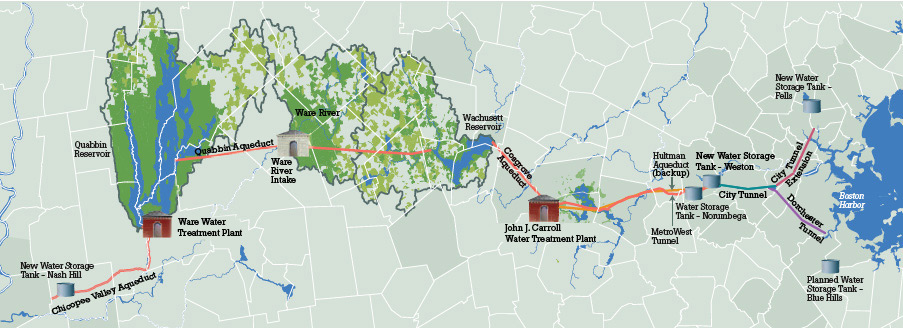
The MWRA does a fairly good job of supplying quality drinking water to the people it serves. The Quabbin Reservoir, located in the western part of the state, was built starting in 1930 and completed in 1939. The building of the Quabbin necessitated the abandonment of four towns, and the damming of the Swift River. It was a massive operation - they had to remove buildings, cemetaries, businesses, a railroad line and relocate all of the residents. This has always seemed very sad to me, although I can see the importance of the project and why it was necessary. At this point, the woods and area surrounding the Quabbin are mostly accessible only via foot traffic in order to protect the water supply. It is a beautiful area.
The MWRA is a publicly owned water system, so no one (in theory) is making money off of the water system. There's nothing really wrong with the MWRA, that I can see, although I'm sure, like any agency, it has its issues. My concern is that the MWRA isn't doing enough to push water conservation. Granted, the Quabbin has plenty of water. But it would be far better to conserve while we can than get into trouble later on. With climate change already occurring, it is difficult to tell what the future might bring, and it would be wise to conserve while we still have plentiful good quality drinking water.
However, I live outside the MWRA service area. We, like many of the towns around us, get our water supplied through residential drinking water wells, which means the local aquifer level is important to me, and I share an aquifer with my neighbors although we each have our own well. I have one neighbor who is fanatical about maintaining a perfect (and large) lawn. They water it regularly - in the middle of the day. Drives me nuts. There are 2 golf courses in town, which also use a ridiculous amount of water, although it's possible they have larger wells that are drawing from a deeper or different aquifer. It's hard to tell - as far as I know, our town has no listing or map of well information (I did go looking for information once...). There is no oversight at all, and as far as I know, no rules regarding water usage or withdrawl rates. Which is fine now - there appears to plenty of water right now. Which is exactly why we should be thinking of this right now, before it becomes an issue.
I was encouraged to read in the Boston Globe today an article about a bill recently passed in Vermont regarding Aquifers in the State of Vermont. If Governor Douglas signs this bill into law, all aquifers in the State of Vermont would be declared a public trust, which would necessitate a state permit for large water withdrawls. This wouldn't do anything about my crazy neighbor and their lawn, but it is a step in the right direction, and puts someone in control of the aquifers, instead of being a complete free for all. The law would also acknowledge that the groundwater in VT is owned by the people of the state, and that the groundwater must be managed by the state as such.
It's a step in the right direction.
In San Antonio, TX, there is the Edwards Aquifer Authority, which protects and manages supply for 1.7 million people - including agricultural (farming and/or ranching), residential and manufacturing uses. The Aquifer is 180 miles long. On the main page of their website, they have today's aquifer level, as well as the 10 day average. This information is also printed in the daily newspaper. There are laws regarding water usage - such as no watering between 10 am and 4 pm, and they can ticket people who waste water by watering their sidewalks/driveways or letting the water run down their street from their property. The Edwards Aquifer Authority also has different action levels based on different aquifer levels, and the information is all right there on the website.
While Massachusetts is in a very different climate than that of south-central Texas, the concept should be the same: the aquifers are a resource for the people, and need to be protected as such. It's a shared resource, and we shouldn't let this resource be a free-for-all until its too late. There are some protections for our aquifer currently under the Mass. Department of Environmental Protection, but the DEP also deals with a great many other issues, and we should have regional aquifer authorities that place the quality and quantity of our aquifers above everything else they do. Perhaps as a subset of the DEP. Maybe this should only apply in the western and central portions of the state, where people actually directly get water from the aquifer they live on top of. But right now, the only local political entity that has any oversight over our drinking water wells is the board of health - and from what I can tell, there is no cohesive organization of that data in my town. If there was a water quality issue, it would be very difficult to determine who is affected in what areas. If wells started to run dry, the only answer would be "go drill a deeper one" (not cheap), which places the burden on the homeowner, and ignores that there may be someone nearby using a larger amount of water than is reasonable, and your well may run dry as a result of their actions.
Monday, April 28, 2008
It's finally raining...
... a little too much. Half an inch today. One to two inches tonight. A quarter to a half-inch tomorrow.
Don't get me wrong, we need the rain. But a 2-day long down pour while everyone is planting their fields isn't a great thing, really. I had to go out and buy some straw (not hay, which contains seeds and will import weeds) to lay on my garden in order to keep the soil from washing away (see my previous post as to why THATS a concern).
Which brought me back to the cover crop idea. Last fall, I planted my first cover crop on half of my garden. The idea of a cover crop is this: it fixes nitrogen, keeps the soil in place, keep the soil slightly warmer (better insulation), and keeps the soil aerated. All of which improves the soil structure. Additionally, during normal growth patterns of a cover crop, organic matter is created via the root system growing on a daily basis. Roots, apparently, are much like our skin in that it regenerates on a regular basis - some of it dies and falls off as new skin is created, and it just keeps cycling through. This is what happens to the roots of cover crops, as well, which is one way that cover crops "fix" nitrogen into the soil.
If the soil is better insulated and better aerated through the use of cover crops, there is the added benefit of increased worm activity in the soil, which also goes great lengths to improving the structure of the soil. The worms (and other bugs) are able to be active later into the fall and earlier in the spring than if the soil had been wiped clean with the fall clean up.
So last fall, I planted (perhaps a little too heavily) a cover crop of winter rye. I spent about $4 on the seed, I think, and put minimal effort into planting it correctly (I threw the seed down, scratched up the soil with a garden rake briefly, and watered occasionally during dry spells). The winter rye had enough time to germinate and get some green growth prior to onset of winter. This spring, as the snow was melting off, I noticed two things: 1) the green parts were still green, UNDER the snow and 2) those areas where I planted the cover crop melted first.
I planted the beans and the peas last week in one of the winter rye areas. For now, I just hoed up a row IN the winter rye, and turned under those areas, leaving the areas in between the rows covered with the winter rye, which was growing so well I didn't have the heart to get rid of it all (it's about a foot high now). My theory is that the winter rye, will prevent unwanted weeds from growing, thus saving me much work while further adding to the soil. I may have to go through and trim it soon, or I may have to hoe it under. I'm supposed to hoe it under, but I hate directions. Winter rye, apparently, will grow to about 5 feet tall, which will definitely cause some issues with water/nutrient use and will compete with the vegetables.
BUT there are other summer-type cover crops, including alfalfa and clovers, which will perform the same function. My basic plan is this: to plant varieties of these two plants in strategic areas. Alfalfa along the road, likely (where I am years away from being able to get anything to grow at all) and in areas where I hope to garden next year, low growing clover IN the garden between the rows and taller clover in the butterfly garden.
Once nice thing about the clover is that it will attract bees, which will be good for the plants and, well, the bees (which are having a terrible time lately).
One drawback is that I'm not sure how hard it will be to get rid of the clover once I introduce it to the garden. Maybe it'll die out over the winter. One can hope. I think if I cut it before it sets seed, I can stop it from reseeding for next year, and it'll die out. But thats a big IF.
Don't get me wrong, we need the rain. But a 2-day long down pour while everyone is planting their fields isn't a great thing, really. I had to go out and buy some straw (not hay, which contains seeds and will import weeds) to lay on my garden in order to keep the soil from washing away (see my previous post as to why THATS a concern).
Which brought me back to the cover crop idea. Last fall, I planted my first cover crop on half of my garden. The idea of a cover crop is this: it fixes nitrogen, keeps the soil in place, keep the soil slightly warmer (better insulation), and keeps the soil aerated. All of which improves the soil structure. Additionally, during normal growth patterns of a cover crop, organic matter is created via the root system growing on a daily basis. Roots, apparently, are much like our skin in that it regenerates on a regular basis - some of it dies and falls off as new skin is created, and it just keeps cycling through. This is what happens to the roots of cover crops, as well, which is one way that cover crops "fix" nitrogen into the soil.
If the soil is better insulated and better aerated through the use of cover crops, there is the added benefit of increased worm activity in the soil, which also goes great lengths to improving the structure of the soil. The worms (and other bugs) are able to be active later into the fall and earlier in the spring than if the soil had been wiped clean with the fall clean up.
So last fall, I planted (perhaps a little too heavily) a cover crop of winter rye. I spent about $4 on the seed, I think, and put minimal effort into planting it correctly (I threw the seed down, scratched up the soil with a garden rake briefly, and watered occasionally during dry spells). The winter rye had enough time to germinate and get some green growth prior to onset of winter. This spring, as the snow was melting off, I noticed two things: 1) the green parts were still green, UNDER the snow and 2) those areas where I planted the cover crop melted first.
I planted the beans and the peas last week in one of the winter rye areas. For now, I just hoed up a row IN the winter rye, and turned under those areas, leaving the areas in between the rows covered with the winter rye, which was growing so well I didn't have the heart to get rid of it all (it's about a foot high now). My theory is that the winter rye, will prevent unwanted weeds from growing, thus saving me much work while further adding to the soil. I may have to go through and trim it soon, or I may have to hoe it under. I'm supposed to hoe it under, but I hate directions. Winter rye, apparently, will grow to about 5 feet tall, which will definitely cause some issues with water/nutrient use and will compete with the vegetables.
BUT there are other summer-type cover crops, including alfalfa and clovers, which will perform the same function. My basic plan is this: to plant varieties of these two plants in strategic areas. Alfalfa along the road, likely (where I am years away from being able to get anything to grow at all) and in areas where I hope to garden next year, low growing clover IN the garden between the rows and taller clover in the butterfly garden.
Once nice thing about the clover is that it will attract bees, which will be good for the plants and, well, the bees (which are having a terrible time lately).
One drawback is that I'm not sure how hard it will be to get rid of the clover once I introduce it to the garden. Maybe it'll die out over the winter. One can hope. I think if I cut it before it sets seed, I can stop it from reseeding for next year, and it'll die out. But thats a big IF.
All the good dirt
Yesterday, I was pleasantly surprised to find an article titled "The Future of Dirt" on the front page of the Ideas section of the Boston Sunday Globe. Yet another sign that the rest of the world is starting to wake up. I can't remember the last time I looked at the Sunday paper and got that really happy feeling just because they are paying attention to something so fundamentally important.
For far too long has our society looked at dirt as something BAD, not something vital. All those vitamins & minerals that we need to live on come from dirt. Think about it. All your veggies contain what you need to survive because it draws them up from the soil. Unless, of course, we're talking about meat - but where do the cows get their nutrients which they then pass up to us? From the grass they graze (if they are so lucky) or from the grain that comes from, yes, yet more soil. A little thing called the food web - perhaps this is bringing back memories of a teacher & a chalkboard? It's a pretty basic concept, and we can't engineer our way out of it.
When we talk about something being "bad" we call it "dirty". When we talked about something messy (like my house), we call it "dirty." Makes it hard to realize consciously how very important good "dirt" is when we are giving it bad connotations all the time. But we can't live without. Cannot.
So what's going on with our soil? It's eroding. We are breaking down its natural structure and it's getting blown away, eroded by heavy rain, or rendered useless via poisoning. How? Heavy tilling, for one, breaks down the physical structure of soil, exposes more of the soil to the air (thereby releasing from the soil carbon dioxide & nitrous oxide - greenhouse gasses - into the atmosphere), and dries it out. Then it rains, or it gets windy, and it blows away. We over plant it, and we plant the same damn crops on it year after year (as in a factory farm growing corn for feed or biofuels), which sucks all the nutrients out of the soil, and leaves the soil prone to a pest infestation for that particular crop. So what then? We fertilize the soil heavily, and over time, the soil becomes salty and laden with petrochemicals. We heavily apply pesticides, which also accumulate in the soil, and prevent the soil critters (the good ones) from doing their job, and the soil further looses its structure. Over time, we might as well be trying to grow that corn in a sandbox for all the nutritional value left in it. (Surprise - you can't grow much in a sandbox).
Have you SEEN the pictures of how muddy the Mississippi River is (or perhaps with your own eyes)? Where do you think all that mud comes from? It's from our farm lands, our suburban areas, our urban run off. It's filling up the Gulf of Mexico and is creating "dead zones" where fish and other sea life cannot live.
The article mentioned above touched on the Farm Bill (which appears to be completely broken and tailored specifically to the needs of the factory farm and big agri-business, yet the masses don't care & couldn't be bothered), which while giving subsidies to large scale farms growing commodities like wheat and corn, but does not do a damn thing for farms practicing good soil conservation - like rotating their crops with alfalfa or soybeans or beans, which fix nitrogen INTO the soil as they grow.
How big of a problem is this? Even I was unaware of how BIG of an issue this is (or perhaps I had merely forgotten). It is estimated (in the globe article) that by 2050, people will have to survive (on average) on less than 1/10th of an acre per person of agricultural land. That is a downright scary picture, and should be keeping you up at night. We've already destroyed so much of our soil. In the northeast, we are lucky enough to live in a "stable" soil region (but our growing seasons is relatively short, and thus not well suited to large scale production agriculture). But most of the US, and most of the inhabited world live in areas that are defined as "degraded" or "very degraded". The deserts are spreading.
According to the wiki, an area of fertile soil the size of Ukraine is lost every year because of drought, deforestation, and climate change. In Africa, by 2025, they will only be able to feed 25% of it's population. The starvation, increased food costs, and rioting that we are seeing now are likely only just beginning.
This isn't a new idea or a new issue. But soil erosion is a long-term issue, not easily dealt with through temporary legislation or in just a few years of farming practice, and in general, humans have really short attention spans. It takes a great many many years to build up good soil. You can't hurry perfection.
We've all heard the current rumblings about the recession, and even perhaps a large scale depression. Remember the last major US depression? What was also occurring at that time? The dust bowl. Here's a great old-time informational video like you would have seen in the fourth grade, complete with warbly music. The wiki, as usual, has a lot of information spelled out for you.
During Roosevelt's 100 first days of his presidency, he started a major campaign to restore ecological balance in the U.S. It would be lovely to have a new president capable of such sweeping reform, but I am not holding my breath, and I think it is likely our very survival is going to be left up to individual citizens who are well informed. Which is why I write this blog (even though I'm pretty sure no one reads it) - just on the off chance that someone, somewhere, runs across it (possibly while looking for something else) and goes off to figure things out for themselves.
For far too long has our society looked at dirt as something BAD, not something vital. All those vitamins & minerals that we need to live on come from dirt. Think about it. All your veggies contain what you need to survive because it draws them up from the soil. Unless, of course, we're talking about meat - but where do the cows get their nutrients which they then pass up to us? From the grass they graze (if they are so lucky) or from the grain that comes from, yes, yet more soil. A little thing called the food web - perhaps this is bringing back memories of a teacher & a chalkboard? It's a pretty basic concept, and we can't engineer our way out of it.
When we talk about something being "bad" we call it "dirty". When we talked about something messy (like my house), we call it "dirty." Makes it hard to realize consciously how very important good "dirt" is when we are giving it bad connotations all the time. But we can't live without. Cannot.
So what's going on with our soil? It's eroding. We are breaking down its natural structure and it's getting blown away, eroded by heavy rain, or rendered useless via poisoning. How? Heavy tilling, for one, breaks down the physical structure of soil, exposes more of the soil to the air (thereby releasing from the soil carbon dioxide & nitrous oxide - greenhouse gasses - into the atmosphere), and dries it out. Then it rains, or it gets windy, and it blows away. We over plant it, and we plant the same damn crops on it year after year (as in a factory farm growing corn for feed or biofuels), which sucks all the nutrients out of the soil, and leaves the soil prone to a pest infestation for that particular crop. So what then? We fertilize the soil heavily, and over time, the soil becomes salty and laden with petrochemicals. We heavily apply pesticides, which also accumulate in the soil, and prevent the soil critters (the good ones) from doing their job, and the soil further looses its structure. Over time, we might as well be trying to grow that corn in a sandbox for all the nutritional value left in it. (Surprise - you can't grow much in a sandbox).
Have you SEEN the pictures of how muddy the Mississippi River is (or perhaps with your own eyes)? Where do you think all that mud comes from? It's from our farm lands, our suburban areas, our urban run off. It's filling up the Gulf of Mexico and is creating "dead zones" where fish and other sea life cannot live.

The article mentioned above touched on the Farm Bill (which appears to be completely broken and tailored specifically to the needs of the factory farm and big agri-business, yet the masses don't care & couldn't be bothered), which while giving subsidies to large scale farms growing commodities like wheat and corn, but does not do a damn thing for farms practicing good soil conservation - like rotating their crops with alfalfa or soybeans or beans, which fix nitrogen INTO the soil as they grow.
How big of a problem is this? Even I was unaware of how BIG of an issue this is (or perhaps I had merely forgotten). It is estimated (in the globe article) that by 2050, people will have to survive (on average) on less than 1/10th of an acre per person of agricultural land. That is a downright scary picture, and should be keeping you up at night. We've already destroyed so much of our soil. In the northeast, we are lucky enough to live in a "stable" soil region (but our growing seasons is relatively short, and thus not well suited to large scale production agriculture). But most of the US, and most of the inhabited world live in areas that are defined as "degraded" or "very degraded". The deserts are spreading.
According to the wiki, an area of fertile soil the size of Ukraine is lost every year because of drought, deforestation, and climate change. In Africa, by 2025, they will only be able to feed 25% of it's population. The starvation, increased food costs, and rioting that we are seeing now are likely only just beginning.
This isn't a new idea or a new issue. But soil erosion is a long-term issue, not easily dealt with through temporary legislation or in just a few years of farming practice, and in general, humans have really short attention spans. It takes a great many many years to build up good soil. You can't hurry perfection.
We've all heard the current rumblings about the recession, and even perhaps a large scale depression. Remember the last major US depression? What was also occurring at that time? The dust bowl. Here's a great old-time informational video like you would have seen in the fourth grade, complete with warbly music. The wiki, as usual, has a lot of information spelled out for you.
During Roosevelt's 100 first days of his presidency, he started a major campaign to restore ecological balance in the U.S. It would be lovely to have a new president capable of such sweeping reform, but I am not holding my breath, and I think it is likely our very survival is going to be left up to individual citizens who are well informed. Which is why I write this blog (even though I'm pretty sure no one reads it) - just on the off chance that someone, somewhere, runs across it (possibly while looking for something else) and goes off to figure things out for themselves.
Saturday, April 26, 2008
Stem Rust... good news keeps coming :-)
Stem rust. I've been hearing more and more mutterings about this recently. I have heard that Iran currently has it, and it would make a great biological weapon on our food security.
Here's the deal. Apparently a wheat stem rust (fungus) epidemic (Ug99) is poised to break out, and is already spreading across Africa, Asia & the Middle East. It started in Uganda in 1999 (hence the name) - not that long ago. It's not a theory - it's already happening. Ug99 is spread via the wind - the wiki page has a more in depth discussion of the life cycle of Ug99, but basically the fungus attacks the above-ground sections of the wheat plant, which decreases the ability of the wheat plant to reproduce.
In the past, stem rust has been a major cause of famines, according to this facisinating opinion piece in the New York Times by Norman E. Borlaug (Nobel Peace Prize winner 1970) titled "Stem Rust Never Sleeps." In the U.S. it caused major crop losses from 1903 to 1905 and from 1950 to 1954. Ug99 is poised to create a global wheat crop loss at a time when wheat stores are at their lowest since the 1940s, and during a time where not only has the world's population increased greatly, but a larger percentage of that population is relying on wheat & grains than they ever have in the past.
So how did "they" stop it from completely killing all of the wheat everywhere? Scientists developed a new kind of wheat - one that was resistant to the fungus and that produced a greater number of seeds. It worked for 50 years. But now, we need to develop a new kind of wheat, and we need the cooperation of the global science community to do it.
Here in lies the rub. As Americans, we have more or less alienated most of the global community (thanks, bush). If we came up with a new & better kind of wheat resistant to stem rust, what do you bet it would be met with skepticism? Let's say, for instance, we came up with the magical wheat and offered it to Iran in order to keep it's children from starving (in exchange for something, I am sure). Do you think they'd actually trust us? I'm not sure I trust us, so I don't really think I can expect a "foe" to trust us.
But that's beside the point. According to Borlaug, while the U.S. was at first very gung-ho on this issue, and provided funding for research & development, we have very suddenly made a 180 and have cut most of the funding. Thanks bush - way to go, man. This guy is AMAZING... in all the wrong ways. I can't wait to see what the history books have to say about him - if we survive that long.
Here's the deal. Apparently a wheat stem rust (fungus) epidemic (Ug99) is poised to break out, and is already spreading across Africa, Asia & the Middle East. It started in Uganda in 1999 (hence the name) - not that long ago. It's not a theory - it's already happening. Ug99 is spread via the wind - the wiki page has a more in depth discussion of the life cycle of Ug99, but basically the fungus attacks the above-ground sections of the wheat plant, which decreases the ability of the wheat plant to reproduce.
In the past, stem rust has been a major cause of famines, according to this facisinating opinion piece in the New York Times by Norman E. Borlaug (Nobel Peace Prize winner 1970) titled "Stem Rust Never Sleeps." In the U.S. it caused major crop losses from 1903 to 1905 and from 1950 to 1954. Ug99 is poised to create a global wheat crop loss at a time when wheat stores are at their lowest since the 1940s, and during a time where not only has the world's population increased greatly, but a larger percentage of that population is relying on wheat & grains than they ever have in the past.
So how did "they" stop it from completely killing all of the wheat everywhere? Scientists developed a new kind of wheat - one that was resistant to the fungus and that produced a greater number of seeds. It worked for 50 years. But now, we need to develop a new kind of wheat, and we need the cooperation of the global science community to do it.
Here in lies the rub. As Americans, we have more or less alienated most of the global community (thanks, bush). If we came up with a new & better kind of wheat resistant to stem rust, what do you bet it would be met with skepticism? Let's say, for instance, we came up with the magical wheat and offered it to Iran in order to keep it's children from starving (in exchange for something, I am sure). Do you think they'd actually trust us? I'm not sure I trust us, so I don't really think I can expect a "foe" to trust us.
But that's beside the point. According to Borlaug, while the U.S. was at first very gung-ho on this issue, and provided funding for research & development, we have very suddenly made a 180 and have cut most of the funding. Thanks bush - way to go, man. This guy is AMAZING... in all the wrong ways. I can't wait to see what the history books have to say about him - if we survive that long.
Friday, April 25, 2008
We Can Solve It...
I don't know if you've seen the ads, but We Can Solve It seems to have invested heavily in ads on HGTV. This is Al's (as in Al Gore) newest attempt to get the ball rolling. I've joined, as have about a million other people (but only a million - there are 6 BILLION people in the world. Come ON!). A million is a mere drop in the bucket. As popular as "green" is today (have you looked at any of the sunday circulars? they all claim to be green - while trying to get you to buy more stuff and throw your old, yet perfectly functioning stuff into a landfill), you'd think there would be more people signing the petition.
Which leads me to the "draft Al Gore for the presidency" people. While I am an Al Gore Fan, it's time to admit that he is WAY more influential dealing solely with the climate issue. He can do much more for the us & the planet from the outside than he can while having to deal with the stupid-er issues of the day. Really, I'd rather have good ole Al doing his climate thing than, say, the annual easter egg hunt on the white house lawn. Let the figure head deal with that crap and install a "first hamster" or whatever pet he or she chooses.
Have you seen the TED talks? Al is too funny to be president. Beside that, if we all paid attention to ANY of the TED talks, we'd be far better off as a planet. I see Amy Tan has given a talk on creativity....
Which leads me to the "draft Al Gore for the presidency" people. While I am an Al Gore Fan, it's time to admit that he is WAY more influential dealing solely with the climate issue. He can do much more for the us & the planet from the outside than he can while having to deal with the stupid-er issues of the day. Really, I'd rather have good ole Al doing his climate thing than, say, the annual easter egg hunt on the white house lawn. Let the figure head deal with that crap and install a "first hamster" or whatever pet he or she chooses.
Have you seen the TED talks? Al is too funny to be president. Beside that, if we all paid attention to ANY of the TED talks, we'd be far better off as a planet. I see Amy Tan has given a talk on creativity....
Rain Barrels at a good price (Mass. area)
I received the following email today from a friend on the re-localization group. For those of you in the Massachusetts area, this might be good information. I got one of these rain barrels last year - way better than the ones I had in Texas (these don't allow mosquitoes to breed & keep all the leaf crap out!). I liked mine so much, I've ordered a second for this year. Go get one. Seriously.
MassToss and MassDEP are offering rain barrels to help residents
conserve water, save money and reduce storm water run-off.
The average homeowner uses approximately 40 percent of water for
outdoor use. A one-inch rainfall on a 1,200 square foot roof will
yield more than 700 gallons of water. Using a rain barrel is an
excellent way to conserve some of this water. A quarter inch run-off
from an average roof will easily fill the barrel. If there are five
storms a season, that equals 275 gallons of free water. Rain barrel
use reduces the stress on municipal water systems during the summer
months and improves storm water management.
The rain barrels are made from 55-gallon blue plastic recycled
containers. The top does not come off, so no children or pets can get
in the barrel. It has a six-inch diameter inlet opening covered with
a screened louver to keep insects and debris out. The barrels have
two brass spigots, one to connect a hose for watering, and one for
overflow. A hose can be connected to the overflow spigot to redirect
the water away from the home. The barrels come with a five-foot hose
with a shutoff valve. Multiple barrels can be joined for additional
capacity.
The first 30 rain barrels ordered can be purchased at the subsidized
price of $56.50 using a MassDEP grant and state contract pricing,
which is considerably less than the retail price, upwards of $89. If
we sell more than 30, we can still offer a discounted price of
$66.50.
To order call 8770-977-3135, toll-free, or order online at
www.nerainbarrel.com.
You do not need to be a resident to purchase the barrels. Offer
expires May 22 for Devens-area pick-up.
Rain barrels will be delivered May 28 at the Devens DPW, 99 Buena
Vista St., Devens, from 3 to 6 p.m.
conserve water, save money and reduce storm water run-off.
The average homeowner uses approximately 40 percent of water for
outdoor use. A one-inch rainfall on a 1,200 square foot roof will
yield more than 700 gallons of water. Using a rain barrel is an
excellent way to conserve some of this water. A quarter inch run-off
from an average roof will easily fill the barrel. If there are five
storms a season, that equals 275 gallons of free water. Rain barrel
use reduces the stress on municipal water systems during the summer
months and improves storm water management.
The rain barrels are made from 55-gallon blue plastic recycled
containers. The top does not come off, so no children or pets can get
in the barrel. It has a six-inch diameter inlet opening covered with
a screened louver to keep insects and debris out. The barrels have
two brass spigots, one to connect a hose for watering, and one for
overflow. A hose can be connected to the overflow spigot to redirect
the water away from the home. The barrels come with a five-foot hose
with a shutoff valve. Multiple barrels can be joined for additional
capacity.
The first 30 rain barrels ordered can be purchased at the subsidized
price of $56.50 using a MassDEP grant and state contract pricing,
which is considerably less than the retail price, upwards of $89. If
we sell more than 30, we can still offer a discounted price of
$66.50.
To order call 8770-977-3135, toll-free, or order online at
www.nerainbarrel.com.
You do not need to be a resident to purchase the barrels. Offer
expires May 22 for Devens-area pick-up.
Rain barrels will be delivered May 28 at the Devens DPW, 99 Buena
Vista St., Devens, from 3 to 6 p.m.
Adoption
Have you ever seriously wished as an adult to find out that you were, in fact, adopted and that somewhere your REAL family is wondering where you are?
I really kind of thought that by THIS point in my life, I would have progressed beyond this fantasy. But sure enough, as soon as we all get together, there it is again... that wondering... "Who ARE these people?"
It's amazing to think that with the same genes, and the same environment, I have turned out so very different from the rest of them. The ONE saving grace is that my younger niece is in many ways very much like me. Which makes me a wee bit worried for her. If the rest of the family can reduce me to near-tears at my age...how hard it is going to be for her in the coming years?
I really kind of thought that by THIS point in my life, I would have progressed beyond this fantasy. But sure enough, as soon as we all get together, there it is again... that wondering... "Who ARE these people?"
It's amazing to think that with the same genes, and the same environment, I have turned out so very different from the rest of them. The ONE saving grace is that my younger niece is in many ways very much like me. Which makes me a wee bit worried for her. If the rest of the family can reduce me to near-tears at my age...how hard it is going to be for her in the coming years?
Thursday, April 24, 2008
International Year of the Potato
No, I'm not kidding; it IS the International Year of the Potato. According to who? The United Nations.
I first heard about this from a guy in the relocalization group, who is a potato fan, and more or less instigated a giant potato buying order (my potatoes are now trying to sprout in my sunroom). When I heard about the year of the potato, I though "aww...how cute." Now, it dawns on me. The UN saw the writing on the wall with the rapid increase in rice and wheat prices. Remember the whole rice rioting thing that's been going on in various places? The UN's answer is potatoes.
Potatoes can grow just about anywhere, if you have a variety thats adapted to your climate. I had some serious potatoes growing in my cabinet this spring, for pete's sake (which I have since stuck in some dirt...and they continue to grow).
According to the UN's potato page, a third of the world's potato production occurs in China & India. 2005 saw a dramatic shift in the balance of world wide potato production with the developing nations outpacing the developed nations in potato production. The U.S. in #5 on the list of top potato producers with 19,460,119 tons; #1 is China with 79,366,428 tons (#2: Russia, #3: India, #4: Ukraine).
Interestingly, the U.S. has by far the highest potato yield per acre in the world with 16.49 tons/acre. Europe is the next contestant with 7.71 tons per acre, and the rest of the regions fall between Europe and the lowest-density producer Africa with 4.83 tons per acre. I imagine the density of yield is directly related to land value. In Europe and N. America, farmers really have to be able to get as much yield as possible out of what land they have in order to stay in business. In the other regions, there are likely still more areas to grow potatoes (outside of densely populated cities). I also wonder how much production density has to do with the type of economy that is in operation in the growing area. While the market-driven economy does have its draw backs, it does force farmers to squeeze all they can (for better or worse) out of their land.
Here's a neat little diagram on HOW potatoes grow. Here's the U.N.s fact sheet on potatoes, including nutritional content and how it will be a key player in solving the world's food shortage keeping the developing nations more stable.
Reuters did an interesting article on potatoes in mid-April. Potatoes are cheap, mostly due to a lack of a financial speculation market - most potatoes aren't exported. This makes farming them difficult on the farmers - they end up selling them cheaply, which means they have to grow and sell a very great many of them & it's labor intensive. BUT for us home gardeners, potatoes are perfect - the seed is cheap and it's nutritious. Less fat than wheat, good source of protein, half of your daily vitamin C intake. They keep pretty well too.
I first heard about this from a guy in the relocalization group, who is a potato fan, and more or less instigated a giant potato buying order (my potatoes are now trying to sprout in my sunroom). When I heard about the year of the potato, I though "aww...how cute." Now, it dawns on me. The UN saw the writing on the wall with the rapid increase in rice and wheat prices. Remember the whole rice rioting thing that's been going on in various places? The UN's answer is potatoes.
Potatoes can grow just about anywhere, if you have a variety thats adapted to your climate. I had some serious potatoes growing in my cabinet this spring, for pete's sake (which I have since stuck in some dirt...and they continue to grow).
According to the UN's potato page, a third of the world's potato production occurs in China & India. 2005 saw a dramatic shift in the balance of world wide potato production with the developing nations outpacing the developed nations in potato production. The U.S. in #5 on the list of top potato producers with 19,460,119 tons; #1 is China with 79,366,428 tons (#2: Russia, #3: India, #4: Ukraine).
Interestingly, the U.S. has by far the highest potato yield per acre in the world with 16.49 tons/acre. Europe is the next contestant with 7.71 tons per acre, and the rest of the regions fall between Europe and the lowest-density producer Africa with 4.83 tons per acre. I imagine the density of yield is directly related to land value. In Europe and N. America, farmers really have to be able to get as much yield as possible out of what land they have in order to stay in business. In the other regions, there are likely still more areas to grow potatoes (outside of densely populated cities). I also wonder how much production density has to do with the type of economy that is in operation in the growing area. While the market-driven economy does have its draw backs, it does force farmers to squeeze all they can (for better or worse) out of their land.
Here's a neat little diagram on HOW potatoes grow. Here's the U.N.s fact sheet on potatoes, including nutritional content and how it will be a key player in solving the world's food shortage keeping the developing nations more stable.
Reuters did an interesting article on potatoes in mid-April. Potatoes are cheap, mostly due to a lack of a financial speculation market - most potatoes aren't exported. This makes farming them difficult on the farmers - they end up selling them cheaply, which means they have to grow and sell a very great many of them & it's labor intensive. BUT for us home gardeners, potatoes are perfect - the seed is cheap and it's nutritious. Less fat than wheat, good source of protein, half of your daily vitamin C intake. They keep pretty well too.
Subscribe to:
Posts (Atom)